BASS-HI
The BASS-HI survey is the largest resolved HI imaging survey of local hard
X-ray-selected AGN host galaxies to date, built on the
BASS survey.
Comprising ~100 targets selected from the parent BASS sample based on distance
and observability, the survey combines new VLA and ATCA observations with
archival data from WSRT, GMRT, and other facilities. Data collection is now
complete (2026.09), and a catalog paper presenting the full sample is currently
in preparation. The survey is designed to address two key questions: how the
presence of an AGN affects the surrounding HI gas reservoir, and how Seyfert
galaxies experience macro-scale (kpc–Mpc) feeding processes.
1) BASS: LI. Cool gas supply of HI-massive local Seyfert galaxies (ADS)
Core Question: How is cool gas supplied to AGN hosts, and does
the environment or gas accretion history play a role in fueling nuclear
activity?
Key Findings:
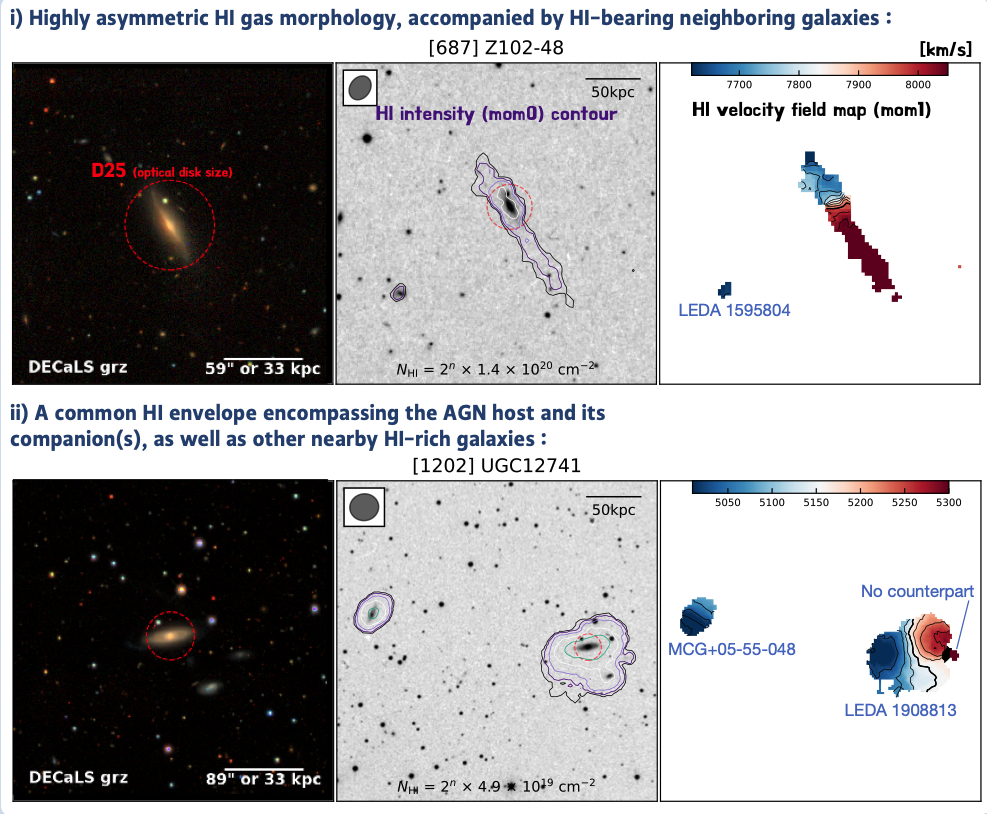
- As a pilot study drawn from the HI-rich subsample of BASS-HI (22 hard
X-ray-selected Seyferts with MHI ≳ 109.7 M☉),
most hosts reside in group-like, gas-rich environments, with 80% showing
HI-detected neighbors.
- Over 60% of these systems exhibit lopsidedness, one-sided gas tails, or
HI structures connecting to companion galaxies, pointing to a history of
gas exchange.
- The sample follows known HI size–mass and star formation scaling
relations, showing no systematic deviation, and are typically the most
massive systems within their groups — more likely to accrete gas
than lose it.
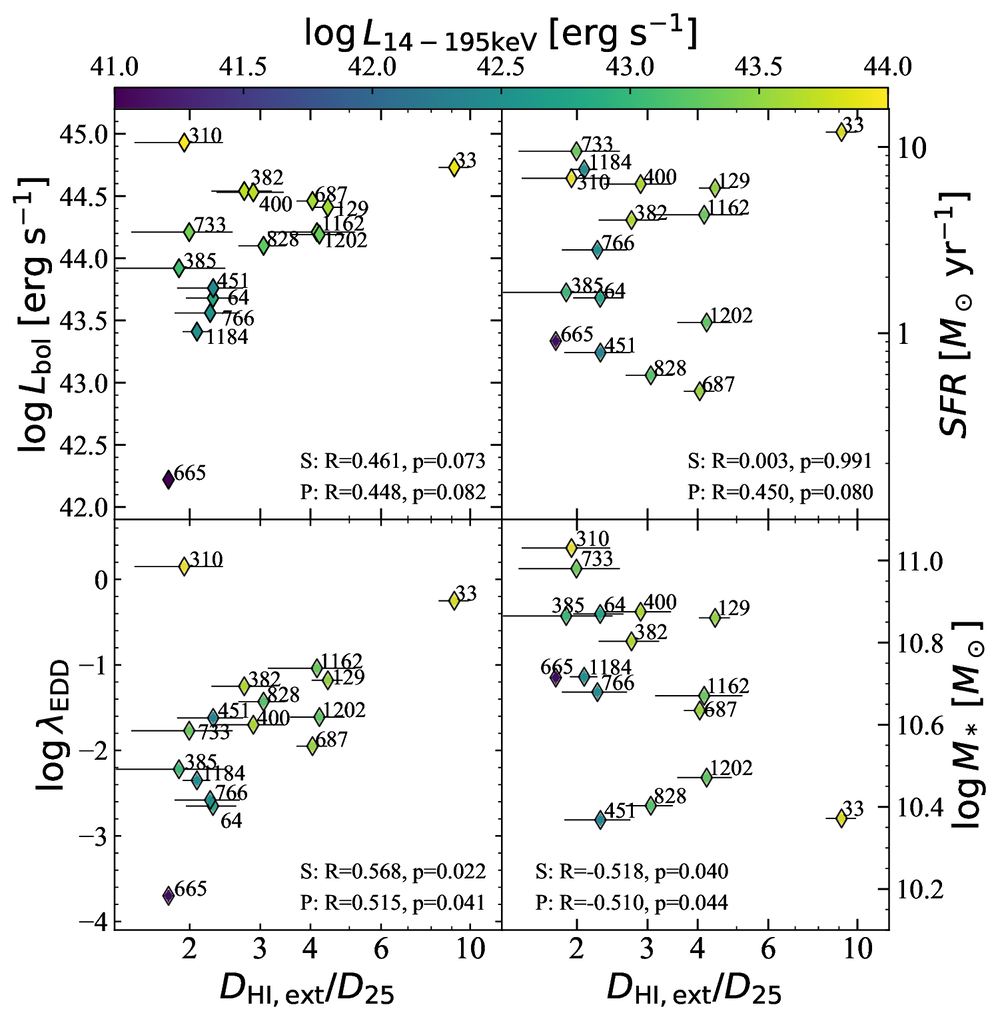
- Galaxies with more extended HI disks show stronger AGN activity, and
this becomes even tighter when neighboring galaxies are HI-poor.
Implications: Extended HI disks are commonly linked to
external processes such as galaxy interactions. The correlation between HI
extent and AGN activity — strengthened when nearby galaxies are likely
the gas source — suggests that environmentally accreted gas may play a
direct role in fueling AGN activity in these systems.
2) BASS-HI catalog
Current ongoing project (TBU).
HI-bearing Dwarfs
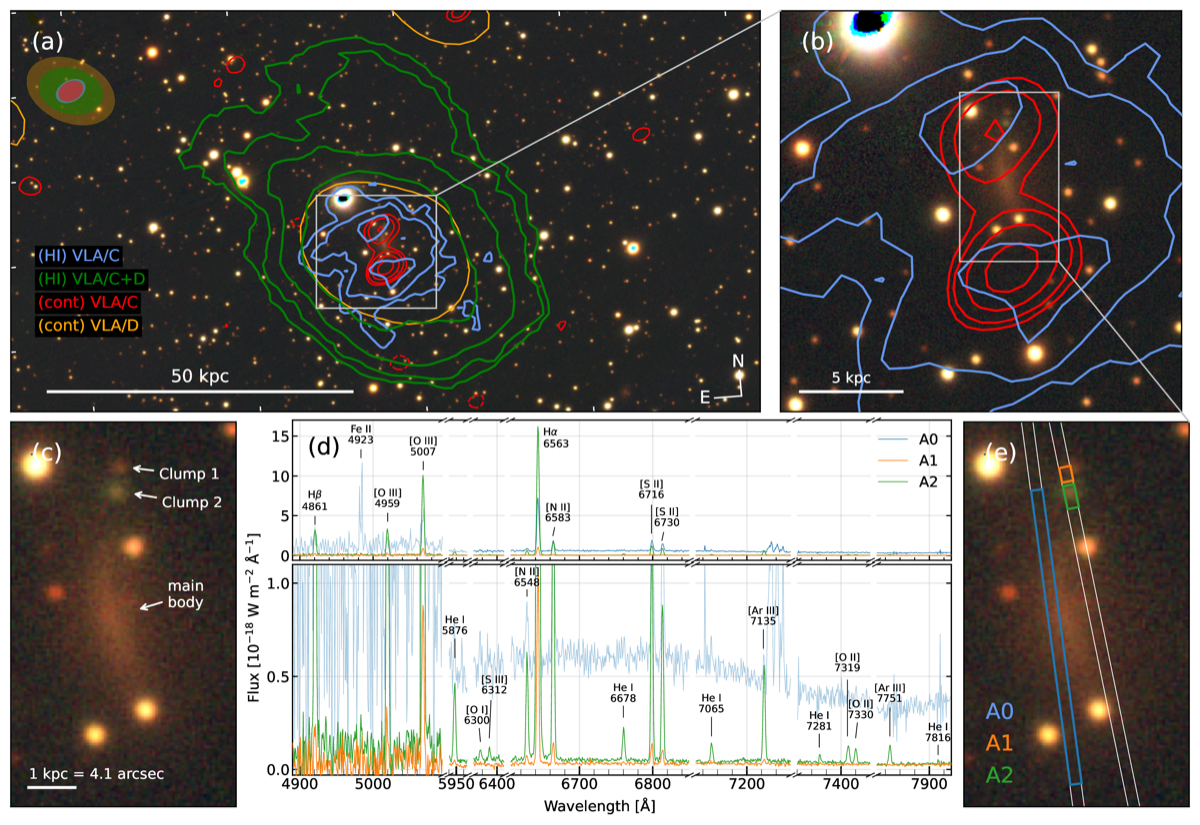
LEDA 136976: A Caterpillar in a Cabbage. An HI-rich dwarf galaxy caught in an active phase of gas accretion and star formation
Core Question: Can gas-rich, optically faint dwarf galaxies
with unusually extended HI reservoirs represent systems in an early, active
stage of mass assembly?
Key Findings:
- LEDA 136976 hosts an unusually large HI reservoir, comparable in extent
and mass to the Milky Way's, despite having less than 10% of its stellar
mass (M⋆ = 3.38 × 10⁹ M☉).
- Both HI and Hα emission show consistent velocity gradients,
confirming rotationally supported dynamics.
- The HI disk shows a disturbed morphology and a kinematically distinct
gas component in the north, suggesting ongoing gas accretion.
Implications: LEDA 136976 appears to be a gas-rich system in
an early stage of stellar mass growth, recently accreted gas which might trigger/enhance star formation.
Such systems may be systematically
underrepresented in optical surveys, motivating HI-based searches for
similar low surface brightness dwarfs.